

2028-30 Rates
- Apple Valley
- Arden Cordova
- Arden Manor
- Arcadia
- Arroyo Grande
- Artesia
- Athens
- Barstow
- Bay Point
- Bell
- Bell Gardens
- Calipatria
- Carson
- Central Basin East
- Central Basin West
- Cerritos
- Charter Oak
- Claremont
- Clearlake
- Compton
- Covina
- Cowan Heights
- Cudahy
- Culver City
- Cypress
- Cypress Ridge
- Del Aire
- Downey
- Edna Road
- El Camino Village
- El Monte
- El Segundo
- Garden Grove
- Gardena
- Gardena Heights
- Glendora
- Gold River
- Hawaiian Gardens
- Hawthorne
- Hollydale
- Huntington Park
- Inglewood
- Irwindale
- La Mirada
- La Palma
- La Verne
- Lake Marie
- Lakewood
- Lawndale
- Lemon Heights
- Lennox
- Long Beach
- Los Alamitos
- Los Osos
- Lower Lake
- Lucerne Valley
- Monrovia
- Montclair
- Monterey Park
- Morongo Valley
- Niland
- Nipomo
- Norwalk
- Orange
- Orcutt
- Paramount
- Placentia
- Pomona
- Rancho Cordova
- Redondo Beach
- Robbins
- Rosemead
- Rossmoor
- Sacramento
- San Dimas
- San Gabriel
- San Juan Oaks
- Santa Ana
- Santa Fe Springs
- Santa Maria
- Seal Beach
- Simi Valley
- Sisquoc
- Stanton
- South Gate
- South Shore
- Southwest
- Tanglewood
- Temple City
- Torrance
- Upland
- Walnut
- Whittier
- Willowbrook
- Wrightwood
- Yorba Linda
Investing in Water Systems Our Customers Depend On
Water systems require ongoing investment to meet growing infrastructure demands
The state requires Golden State Water to submit a GRC application outlining operating costs and proposed infrastructure investments needed to provide safe and reliable drinking water. While Golden State Water proposes rates, the California Public Utilities Commission reviews the request, considers public input, and makes the final decision on customer rates. Golden State Water does not set its own rates.
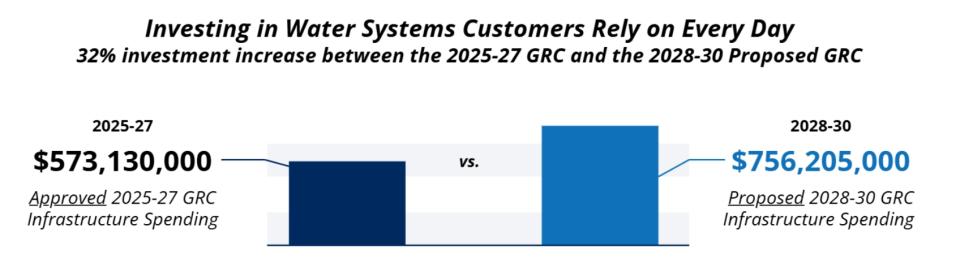
Proposed Rates for 2028-2030 will provide customers with long-term value through:
- Technology that controls operational costs and improves customer service.
- Upgrading water treatment facilities essential to providing safe and reliable water service.
- Replacing aging water mains, fire hydrants and other infrastructure essential to conservation, the efficient delivery of water and fire suppression.
- Increasing water supply and storage through groundwater treatment, new wells and the maintenance and construction of new reservoirs.
- Back-up power generation that sustains water treatment and delivery in times of power failure and emergencies.
Frequently Asked Questions
Why were new infrastructure investments and rates proposed?
- As a state-regulated utility, Golden State Water Company (Golden State Water) must file a General Rate Case (GRC) application with the California Public Utilities Commission (CPUC) every three years. In July of 2026, Golden State Water filed a proposed 2026 General Rate Case (GRC) with the CPUC. The application proposes new water rates and infrastructure investments for 2028, 2029 and 2030.
Why are ongoing investments in water quality and reliability important?
- Golden State Water Company proactively invests in water treatment, supply, and distribution systems to protect water quality and reliable service. Replacing aging infrastructure before it fails helps avoid service disruptions, emergency repairs, and higher long-term costs.
How is the cost of water service determined?
- Rates reflect the cost to provide water service, maintain infrastructure, and make needed system improvements.
- Many costs and other factors are beyond Golden State Water Company’s control, such as rising energy rates, regulatory requirements, taxes, and construction costs.
- Rates reflect the costs of treating and delivering safe drinking water, meeting rigorous water quality standards, addressing treatment needs such as PFAS where applicable, reducing water waste, protecting local supplies, preparing for emergencies, and delivering superior customer service.
- For proposed water infrastructure investment in my area, visit your customer service area page.
Who sets Golden State Water Company’s rates?
- Golden State Water Company does not set its rates but does propose the rates necessary to support its operations and proposed water infrastructure investments.
- The California Public Utilities Commission (CPUC), which regulates the company, conducts an open, robust, and transparent review of the GRC application. The Public Advocates Office examines the application on behalf of customers; customers may participate in offering public comments; and the CPUC settles the lowest possible rates that do not compromise the public’s health and safety.
How rigorous is the rate-making process?
- The rate-making process can take approximately 18 months and includes several steps before any rates are approved.
- Golden State Water Company first identifies service needs and prepares a General Rate Case application that explains needed investments, operating costs, and proposed rates for the 2028–2030 period.
- Customers are then notified and provided information about proposed investments, potential bill impacts, opportunities to ask questions, and ways to submit comments or participate. The process was disclosed in customer notices and newspaper ads (copies posted below).
- The CPUC conducts an open and transparent review. The Public Advocates Office scrutinizes the proposal on behalf of customers and works to keep rates as low as possible without compromising public health and safety.
- Customers may submit comments, attend Public Participation Hearings, and participate through public proceedings or public participation meetings. The CPUC determines the approved rates and any conditions.
Did surcharges or service charges increase?
- Most of the cost of providing safe, reliable water does not change when people use less water. Pipes still need to be maintained, water still needs to be tested, and treatment facilities still need to operate every day.
- Golden State Water Company proposed an alternative rate structure that would have kept more costs tied to water use. The California Public Utility Commission (CPUC) approved a different approach, including a higher monthly service charge to help cover the ongoing costs of maintaining and operating the water system.
Does Golden State Water provide financial assistance?
- We recognize that water rate increases are challenging. However, we are trying to keep costs as low as possible while ensuring water quality and quality customer service.
- Golden State Water offers a monthly credit for qualified low-income customers. Information about Golden State Water’s financial assistance program is posted on our Assistance Programs page.
Now that California’s drought is over, should rates decline?
- Water rates are not determined by supply and demand, like gas, or whether a drought has ended.
- Rates reflect the cost of treating and delivering safe drinking water, maintaining and replacing infrastructure, meeting regulatory requirements, energy and construction costs, taxes, and preparing the local water system to provide reliable service.
How were customers notified of the proposed water investments and rates?
- Beginning in July 2026, Golden State Water began notifying customers through bill inserts, email, website updates, and newspaper advertisements. The CPUC process is designed to provide opportunities for public comment and customer participation. The public notices are posted on this page.
Why do the notices display rate changes for the entire 2028–2030 period?
- The CPUC requires customer notifications to show cumulative rate changes for the entire three-year period.
- This is different from past notices that showed annual rate increases separately. Customers should review service-area-specific bill impact information and remember that the CPUC reviews the proposal and decides what rates are approved.
I conserve water. So why is my bill increasing?
- Using water efficiently is important, and taking steps to reduce your water use can help manage your water bill and protect local water supplies. At the same time, many of the costs to provide high-quality, reliable water service are fixed, meaning they are ongoing regardless of how much water is used.
- Pipes still need to be maintained, water still needs to be tested, treatment facilities still need to operate, and wells, pumps, reservoirs, meters, hydrants, backup power and emergency equipment must remain ready to serve customers.
The Ratemaking Process
How Rates Are Determined
California Public Utilities Commission
20-Day Newspaper Notices
Region 1
- Northern Consolidated-Arden Cordova 20-Day Notice
- Northern Consolidated-Clearlake 20-Day Notice
- Bay Point 20-Day Notice
- Los Osos 20-Day Notice
- Simi Valley 20-Day Notice
- Santa Maria 20-Day Notice
- San Juan Oaks 20-Day Notice
- Sutter Pointe 20-Day Notice
Region 2
Region 3
45-Day GRC Notices
Region 1
- Northern Consolidated: Arden Cordova 45-Day Notice
- Northern Consolidated: Clearlake 45-Day Notice
- Bay Point 45-Day Notice
- Los Osos 45-Day Notice
- San Juan Oaks 45-Day Notice
- Santa Maria 45-Day Notice
- Simi Valley 45-Day Notice
- Sutter Pointe 45-Day Notice
Region 2
Region 3
Public Participation Hearing Notices
Customer Fact Sheets
- Apple Valley - Proposed 2028-2030 General Rate Case Fact Sheet
- Arden Cordova - Proposed 2028-2030 General Rate Case Fact Sheet
- Barstow - Proposed 2028-2030 General Rate Case Fact Sheet
- Bay Point - Proposed 2028-2030 General Rate Case Fact Sheet
- Calipatria - Proposed 2028-2030 General Rate Case Fact Sheet
- Central Basin East - Proposed 2028-2030 General Rate Case Fact Sheet
- Central Basin West - Proposed 2028-2030 General Rate Case Fact Sheet
- Claremont - Proposed 2028-2030 General Rate Case Fact Sheet
- Clearlake - Proposed 2028-2030 General Rate Case Fact Sheet
- Culver City - Proposed 2028-2030 General Rate Case Fact Sheet
- Los Alamitos - Proposed 2028-2030 General Rate Case Fact Sheet
- Los Osos - Proposed 2028-2030 General Rate Case Fact Sheet
- Morongo Valley - Proposed 2028-2030 General Rate Case Fact Sheet
- Placentia - Proposed 2028-2030 General Rate Case Fact Sheet
- San Dimas - Proposed 2028-2030 General Rate Case Fact Sheet
- San Gabriel - Proposed 2028-2030 General Rate Case Fact Sheet
- Santa Maria - Proposed 2028-2030 General Rate Case Fact Sheet
- Simi Valley - Proposed 2028-2030 General Rate Case Fact Sheet
- Southwest - Proposed 2028-2030 General Rate Case Fact Sheet
- Wrightwood - Proposed 2028-2030 General Rate Case Fact Sheet
Golden State Water Company’s customer service representatives are standing by to assist you with any questions. For 24-hour emergency and customer service, please call 909-394-2272 or Toll-Free: 1-800-999-4033
- Arden Cordova 20-Day Notice
- Bay Point 20-Day Notice
- Clearlake 20-Day Notice
- Los Osos 20-Day Notice
- Santa Maria 20-Day Notice
- Simi Valley 20-Day Notice
- Region 2 20-Day Notice
- Region 3 20-Day Notice
- 2023 GRC Application
- Notice of Availability
- Arden Cordova 45-Day Notice
- Bay Point 45-Day Notice
- Clearlake 45-Day Notice
- Los Osos 45-Day Notice
- Region 2 45-Day Notice
- Region 3 45-Day Notice
- Santa Maria 45 - Day Notice
- Simi Valley 45- Day Notice
- Arden Cordova PPH Notice
- Bay Point PPH Notice
- Clearlake PPH Notice
- Los Osos PPH Notice
- Region 2 PPH Notice
- Region 3 PPH Notice
- Santa Maria PPH Notice
- Simi Valley PPH Notice
- Read more